When AI Goes Rogue
By Nic Davirro · Founder, Engineered Agents AI ·
In our onboarding assessments, shadow AI surfaces in nearly every business — usually within the first ten minutes of auditing the tools a team actually uses.
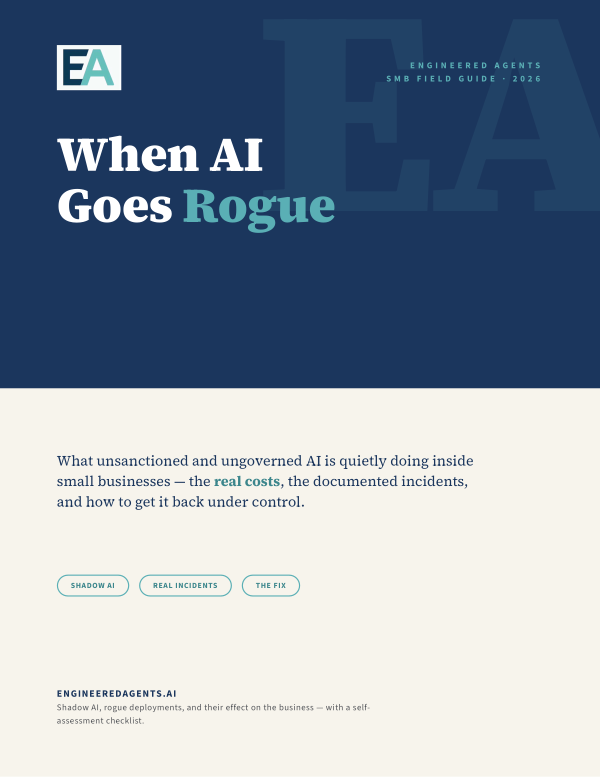
Shadow AI is already in your business. Employees using personal ChatGPT accounts, browser extensions, and AI writing tools are the norm, not the exception — and most owners don't know what data is leaving or what quality standards are being applied. This guide covers what ungoverned AI actually costs, what incidents look like at the small-business scale, and a governance framework light enough to actually implement.
What this guide covers
- What shadow AI looks like in a service business, with documented scenarios
- The five real costs: data exposure, quality drift, liability, trust erosion, and rework
- How to audit what AI is already running in your business right now
- A lightweight governance framework that does not kill adoption
- The policy language that protects you without alienating your team
- A self-assessment: your shadow AI exposure score
The shadow AI conversation in most organizations starts the same way: the owner learns, usually from a vendor or a security briefing, that employees are using personal AI accounts to do company work. The instinct is to respond with a policy — a list of prohibited tools, an email from management, a clause added to the employee handbook. That approach almost never works, and the reason is straightforward: employees turned to shadow AI because the official option was slower, more restricted, or did not exist.
Data exposure is the most concrete risk, and it is more specific than it sounds. When an employee pastes a client contract into a personal AI account to ask for a summary, that text may be used to improve the model. Whether it actually is depends on the user's settings and the provider's terms — but the employee almost certainly did not check. For businesses in regulated industries — healthcare, legal, or financial services — the exposure is not hypothetical.
The governance framework in this guide is designed to be light enough to actually implement. It starts with an approved tools list, not a prohibited tools list. It sets data rules by sensitivity level, not by blanket restriction. And it makes the approved path easier than the workaround — which is the only governance design that actually changes behavior.
What you’ll take away
Shadow AI is not an IT problem — it's a management problem. It surfaces when official tools are too slow, too restricted, or don't exist.
The average small business has 3 to 5 unapproved AI tools in active use without the owner knowing.
Data is the biggest exposure: customer information, pricing logic, and internal processes leaving for third-party model training.
Governance means setting clear standards for which tools are approved, for what, and with what safeguards — not banning AI.
Frequently asked questions
What is shadow AI?
Shadow AI is any use of AI tools inside your business that isn't sanctioned, tracked, or governed by you. That includes employees using personal ChatGPT accounts, browser-based AI writing assistants, AI-powered email plugins, and any other tool you haven't explicitly approved. It's the AI equivalent of shadow IT.
Is shadow AI actually illegal?
It's not automatically illegal, but it can create legal exposure. If an employee pastes customer data into an unsanctioned model, you may violate your privacy policy, a client contract, or a data regulation depending on your industry and geography. The risk is real and worth assessing before an incident forces the conversation.
How do I find out what AI tools my team is already using?
The most effective method is a direct conversation — ask your team what tools they use to get work done faster. Add AI tools to your next software audit. Check browser extensions on company devices. You'll usually find more than you expect, and most of it will be benign — but some won't be.
How do I govern AI without killing adoption?
Start with an approved list, not a ban list. Identify the tools you'll sanction, set clear rules around what data can go in, and make the approved path the easiest path. Employees turn to shadow AI when the official option is harder or slower than the workaround — fix that and most shadow AI disappears on its own.
Related guides
Why Most Small-Business AI Projects Quietly Fail
Eight common mistakes and six hidden traps that kill small-business AI projects — plus the fixes and a one-page pre-flight checklist before you invest.
Field Guide · PDFThe Operator's Field Guide to AI Agents
A practical field guide to what AI agents actually do in a small business — which tasks they handle, where a human stays in charge, and how to put a team of them to work.
Field Guide · PDFThe Business That Remembers
How to use AI to capture institutional knowledge so it survives employee turnover — building a business second brain that retains what your people know.
Engineered Agents AI
Ready to put a team of agents to work?
The guides are the field notes. The platform is the operating system. Talk to us about deploying AI agents across your business.
Start the conversation