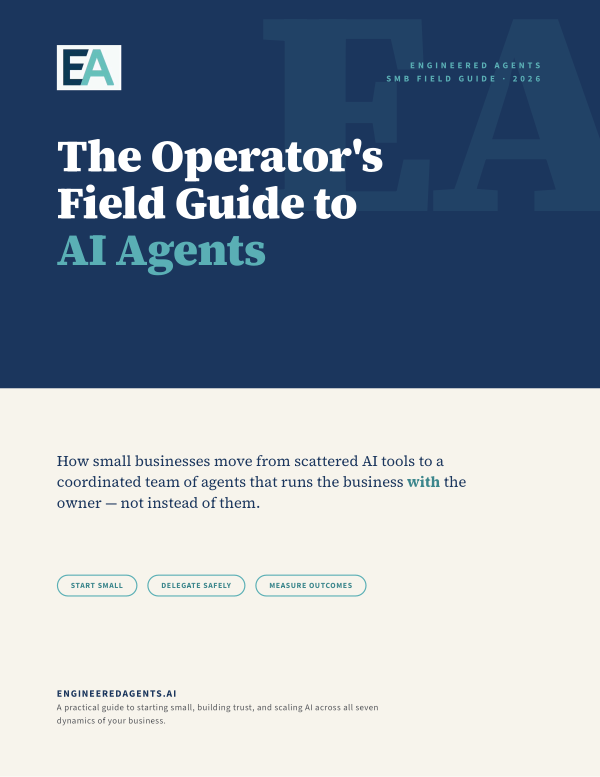
The Operator's Field Guide to AI Agents
By Nic Davirro · Founder, Engineered Agents AI ·
Engineered Agents AI has deployed agent systems across finance, marketing, and operations for small businesses — this guide distills what we learned.
AI agents are software workers that carry out business tasks on their own — drafting content, reconciling invoices, following up on leads — without waiting for you to prompt them each time. In a small business, the highest-value agents cover marketing, finance, and operations, where repetitive, judgment-light work piles up fastest. A human stays in charge of anything that requires relationship judgment, legal decisions, or brand voice approval.
What this guide covers
- What agents actually do vs. what they cannot do
- The seven business areas where agents earn their keep fastest
- How to deploy a first agent without disrupting existing workflows
- The approval layer: what should always require owner sign-off
- Real examples of agent output in a service business
- A self-assessment: which tasks on your desk belong to an agent
The confusion about what AI agents are usually starts with the word 'agent.' Most owners picture an autonomous robot making decisions. The reality is more useful and more controllable than that. An agent is a software worker with a clearly defined job: it runs when triggered, follows a set of instructions, uses tools you give it access to, and produces an output you can review. It does not improvise, and it does not go looking for work outside its scope.
The businesses that get the most from their first agent deployment are usually the ones that resist the urge to start big. One agent. One job. One system it connects to. When that works — and it usually does within the first two to three weeks — the operational logic for the next agent becomes obvious. Finance teams at small businesses typically see the clearest early wins: invoice reconciliation, expense categorization, and cash flow summaries are structured, rule-based tasks that agents handle without calibration.
The approval layer is what separates an agent that saves you time from one that creates liability. Before any agent touches something that represents your business externally — an email to a client, a social post, a response to a complaint — the output should sit in a review queue. Not because agents get it wrong frequently, but because the cost of getting it wrong publicly is high. The field guide maps this approval layer across task types so you know exactly where to draw the line.
What you’ll take away
Agents aren't magic — they're structured workers with narrow, well-defined jobs.
The best first deployment is whichever repetitive task costs you the most time this week.
Owner judgment stays in the loop for anything that touches trust, money, or your brand.
A team of agents covering all seven business areas is cheaper than one full-time hire.
Frequently asked questions
What is an AI agent and how is it different from ChatGPT?
ChatGPT answers questions when you ask them. An AI agent runs on a schedule or trigger, carries out a defined task without being prompted, and can connect to your tools — your CRM, your accounting software, your email — to get things done. Think of it as the difference between a search engine and a new employee.
Which part of my business should I automate first?
Start with the task you do most often that doesn't require a judgment call. For most service business owners, that's some combination of follow-up emails, social content, or financial reconciliation. These have clear inputs and outputs — exactly what agents handle best.
Will an AI agent make mistakes?
Yes — and that's why the guide covers the approval layer in detail. The right setup has agents completing work and flagging it for your review before it goes out, not operating without any human checkpoint. You stay in charge; the agent handles the legwork.
How long does it take to set one up?
A well-scoped first agent — one clear task, connected to one system — typically takes a few hours to configure and a week or two to calibrate. The biggest time cost is usually writing the job description: what the agent is supposed to do and how it should handle edge cases.
Related guides
AI Across the 7 Dynamics
Where AI earns its keep across the seven core areas of a business — and where a human stays in charge. A practical framework for owners planning an AI strategy.
Field Guide · PDFWhat AI Actually Costs
The honest guide to what AI actually costs a small business — total cost of ownership, build vs. buy vs. DIY, and a real ROI frame to tell if it's paying off.
Field Guide · PDFWhy Most Small-Business AI Projects Quietly Fail
Eight common mistakes and six hidden traps that kill small-business AI projects — plus the fixes and a one-page pre-flight checklist before you invest.
Engineered Agents AI
Ready to put a team of agents to work?
The guides are the field notes. The platform is the operating system. Talk to us about deploying AI agents across your business.
Start the conversation